
Adding learning and home practice to our kids' games
After the holiday games took off, I added maths, reading and geography matched to the Western Australian Curriculum, then a short daily home practice and reports for teachers. Built in Claude, hosted on Backlit.
By Matt Edwards, co-founder of Backlit.
The holiday games worked. The kids played them every day, and so did their friends. That raised an obvious question. If they’re going to play anyway, could they learn something while they do?
Learning inside the games
The school curriculum is public. Western Australia publishes what children are expected to learn in each year, subject by subject. So I asked Claude to work from it and build short learning moments into the games, matched to each child’s school year.
Now the questions are part of play:
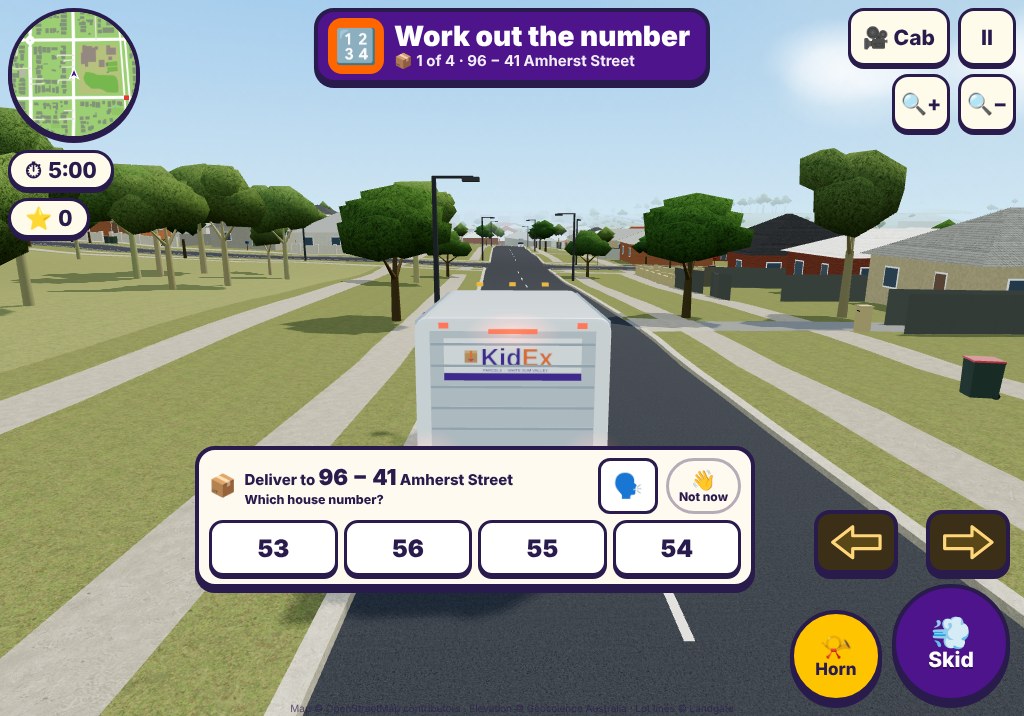
- In KidEx Delivery, the house number you’re delivering to is a sum.
- In Gang Up, the bibs carry numbers or letters to tag.
- On the bus, you count who gets on.
- In Dustbin Dash, it’s which bin, or how many.
Every question can be skipped, and there’s no buzzer for a wrong answer. Ignore one and it quietly goes away. Parents choose roughly how many questions a round has, or switch learning off.
Then home practice
Questions inside games are practice in passing. Some things need a few focused minutes. So the next step was Home Practice: a short daily session at the child’s own year level.
- Times tables on a mat, and saying a table out loud to a grown-up, who taps Got it or Again.
- Quick number facts.
- Sounds, words and spelling.
- Geography: the globe and the poles, continents and oceans, then states, capital cities and WA towns on real maps.
When the day’s minutes are done, the child earns their treat, usually game time. Parents can set the games to wait until practice is done, and send a stamp: Great effort, You kept going, You worked it out, Proud of you. There are no streaks to break and no practice leaderboards.
Reports for teachers
This week I shared a report with the kids’ teachers on the home practice they’ve been doing. A report like this covers, for each child:
- how many days they practised, and for how long
- which subjects and activities they did
- each skill for their year, marked not started, practising or known
- times tables and number facts, measured on getting it right first time rather than on speed
- what’s going well and what to work on next
Right first time is the useful measure. A fast answer that’s wrong doesn’t tell a teacher much. A right answer, first go, shows what’s actually sticking.
Where Backlit comes in
Learning data is about children, and it belongs to their family. It needs handling with care.
- Each family’s data is separate. Progress and practice are stored per family on Backlit. No other family can see them.
- Parents are in charge. Learning and practice settings live in the grown-ups area, behind a PIN.
- It works offline. The home-screen app opens without a network, and practice syncs when the network is back.
- The data can come back out. Because the practice data lives on Backlit, Claude can read it back through the connector. That’s what makes a report like this a question you can ask, not a spreadsheet you have to build.
All of it was built in Claude, on my phone, with no developers. Claude worked from the curriculum and wrote the questions. Backlit kept the data private and shared with the right people.
Next: teaching junior cricket’s rules, and its strange names, through a game.
Built an app with Claude or ChatGPT? Get started with Backlit and share it in seconds.